
Human Health Risk Assessment
A study to evaluate both short-term and long-term health risks in the community.
Introduction to the OWEF
The Olmsted Waste-to-Energy Facility (OWEF) is a key component of the Olmsted County integrated solid waste management system. Our system is modeled after the Minnesota solid waste hierarchy and includes: waste reduction & education, hazardous waste facility, recycling center plus, yard waste compost site, OWEF, Kalmar Landfill.
Built in 1987, the OWEF recovers energy from waste that would otherwise be disposed of in a landfill. The process recovers the energy and reduces greenhouse gas emissions and the volume of waste by approximately 90%, extending landfill life and minimizing environmental liabilities.
With the two original boilers from 1987, plus a third, larger boiler added in 2010 to accommodate the growing community in Olmsted County, the OWEF is capable of processing 400 tons of waste a day.
Purpose of the study
As a Title V Air Permit facility, the OWEF is subject to strict limits and standards on its emission outputs. Olmsted County commissioned a Human Health Risk Assessment with Stantec Engineering to evaluate whether the air emissions from the OWEF pose any risk to public health. The analysis examined pollutant exposure within a 10-kilometer (6.2 mile) radius of facility and followed both US Environmental Protection Act and Minnesota Pollution Control Agency risk assessment guidance. The study of the facility evaluated both short-term and long-term health risks.
How the study was conducted
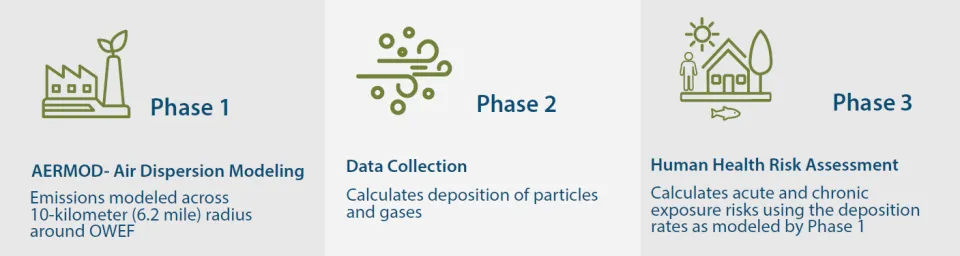
The study was executed in two phases. First, air dispersion models assessed where the emissions from the facility’s stacks typically deposit in the environment. This analysis incorporated five years of local meteorological data, land use, terrain, seasonal conditions, and the surrounding built environment.
Second, risk assessment modeling calculated acute and chronic exposure risks, using the deposition rates as modeled by the first phase. This modeling used a comprehensive approach, considering not only direct inhalation pathways, but also indirect exposure pathways such as soil deposition, uptake into garden produce, fish consumption from nearby water bodies, and other EPA mandated scenarios.
The model evaluated impacts across a dense grid of locations throughout the community and included specific sensitive receptors such as schools, hospitals, daycares, and nursing homes.
All parameters that the OWEF is subject to under its air permit were modeled, including but not limited to: heavy metals, particulate matter, acid gases, and dioxin/furans.
Conservative approach and safety margins
The assessment was intentionally designed to overestimate risk; the facility was modeled at its highest potential risk levels. Modeling assumptions included using maximum allowable emission rates rather than actual operating emission rate (often times increasing the emission rates over 100 times of what the facility has actually tested as its outputs), assumes continuous lifetime exposure at the locations of highest estimated accumulation, incorporating high-end consumption rates of locally produced food. Additionally, the most current and productive toxicity values were also applied for all pollutants.
Findings
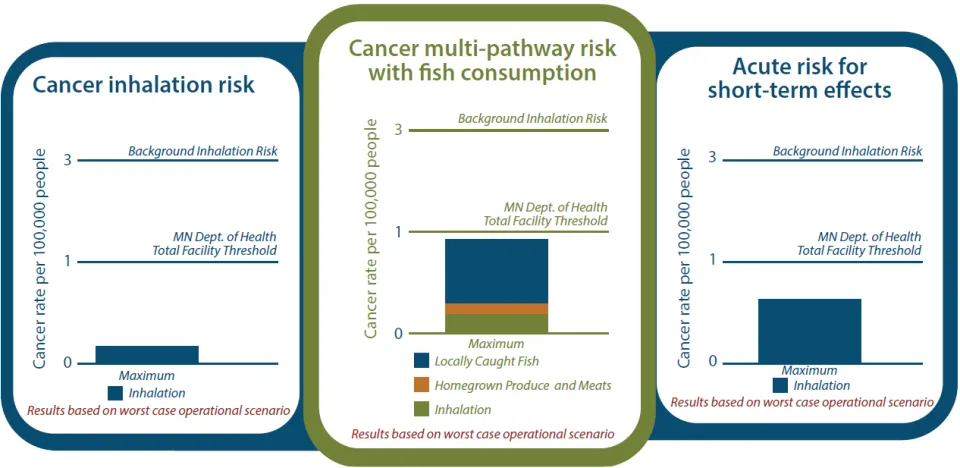
The results of the Human Health Risk Assessment demonstrate both long and short-term health risks are below both the Minnesota Department of Health’s facility threshold risk limit and below background risks in the region. Even in the highest exposure scenarios, i.e., living 24/7 in the greatest exposure area, eating fish for five meals a week out of Silver Lake, risk levels
remain below risk thresholds.
Full Report
For a full copy of the report, please email reducewaste@olmstedcounty.gov.