
Materials Recovery Facility (MRF) construction update
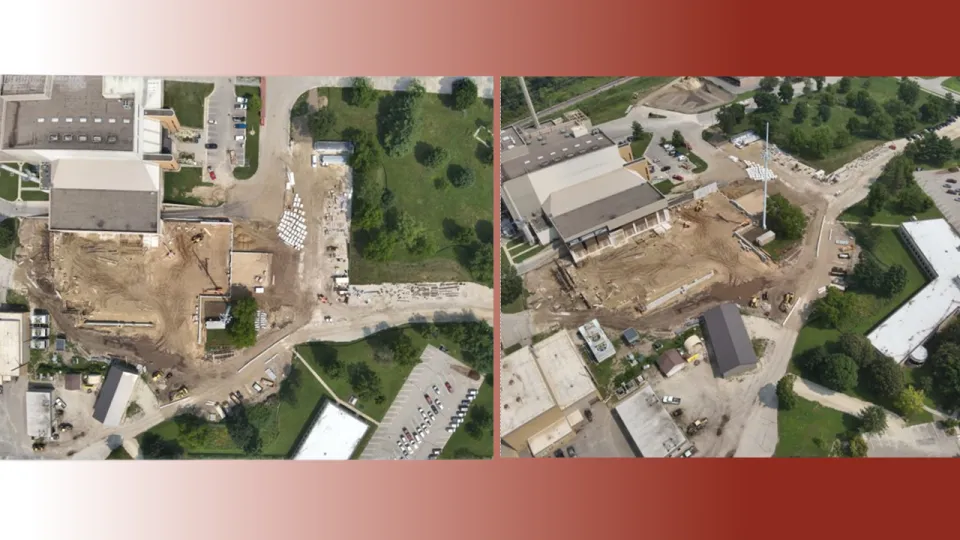
Olmsted County continues to make steady progress on the new Materials Recovery Facility (MRF), funded in part by $10 million from the State of Minnesota’s 2023 capital investment bill. The MRF is being built as an adjoining facility next to the Olmsted Waste-to-Energy Facility (OWEF) and will play a major role in strengthening our regional recycling system.
Construction progress
Major MRF construction work is underway. Recent progress includes:
- Rerouting the public water main and sanitary sewer.
- Installing new stormwater piping and constructing a stormwater pond west of the Olmsted County Recycling Center Plus.
- Pouring major footings and foundation walls along the building perimeter.
- Removing sections of the south OWEF wall to connect the OWEF tipping floor to the new MRF tipping floor.
- Relocating the emergency generator cooler to make space for MRF access and the new water main route.
- Completing structural fill and soil correction work to prepare the MRF footprint.
Crews continue to address challenges related to the electrical duct bank, steam tunnel, and cell tower utilities. Coordination among multiple utility partners has been critical.
Upcoming work and completed milestones
The project is on schedule with the tentative timeline shown below. Key milestones include:
- Completion of underground utilities – complete
- Concrete footings and slab work – through November 2026
- Arrival of pre‑engineered metal building materials – early September 2026
- Building construction – September 2026 through February 2027
- Equipment delivery – December through February 2027
- Equipment installation – February through June 2027
- Commissioning and testing – July through September 2027
- Commercial operations – September 2027
Why MRF matters
A MRF is a high‑tech facility where people and machines work together to sort household recyclables. Today, mixed recyclables collected at the curb are trucked to the Twin Cities for processing. By building a regional MRF in southeastern Minnesota, Olmsted County will reduce long‑distance transportation, cut greenhouse gas emissions, strengthen local recycling markets, and support businesses across the region.
The MRF will also remove more recyclable and non‑combustible material from the waste stream, improve the reliability of the OWEF, reduce operating costs, and delay a costly expansion of the waste‑to‑energy facility. Removing items such as glass, metal, and grit will improve the quality of the material burned at the OWEF and slow the rate at which ash fills the Kalmar Landfill.
Even with this new technology, good recycling habits at the curb continue to be essential.
Look to the front page of this website for regular updates on construction progress and the community benefits of the MRF.